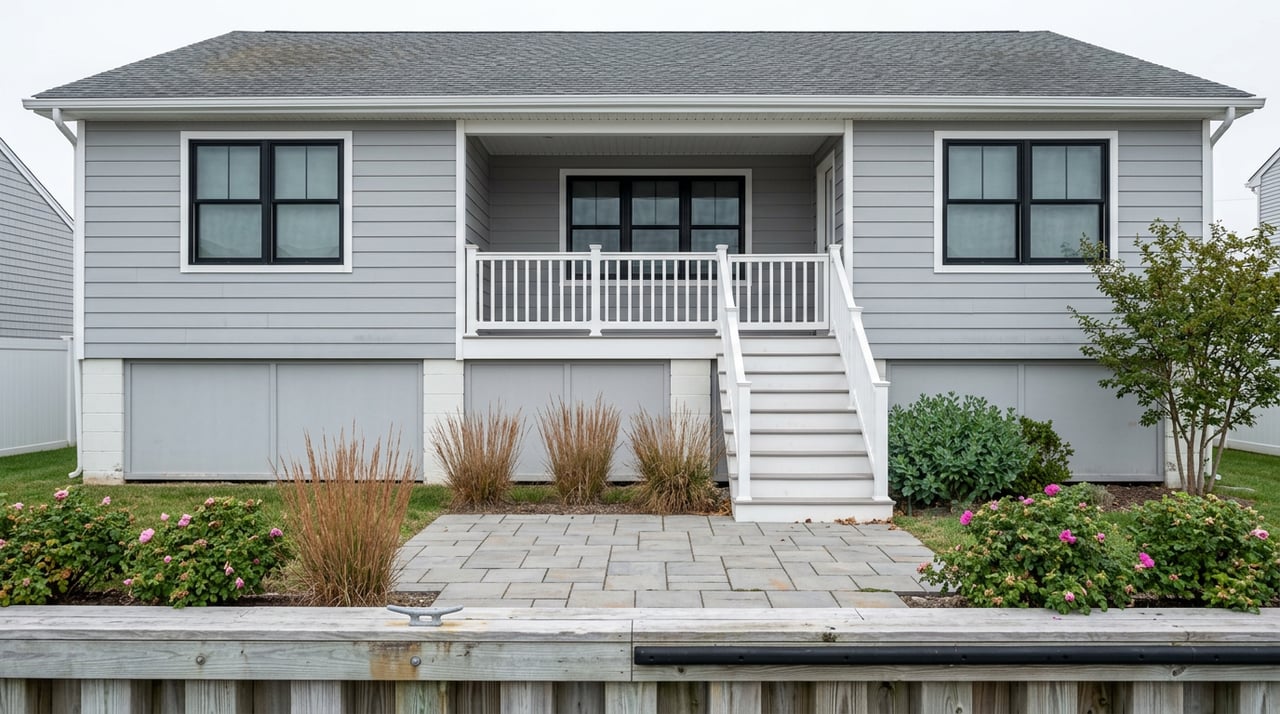
Two homes for sale on Seaford's canals right now tell opposite stories about the same feature. One listing leads with "Low Low Flood Insurance" as a selling point, right next to a $16,100 tax bill and 90 feet of bulkhead. The other, a raised Cape on Island Channel Road, sits in FEMA Zone AE and says so directly, explaining that its raised construction is exactly what earns it a reduced insurance rate. Same hamlet, same canal-adjacent geography, two completely different flood insurance stories.
That gap is the thing buyers miss when they price a Seaford waterfront home off the sale price alone. The number that actually decides what you pay every month to keep the house insured has almost nothing to do with how close you sit to the water. It has everything to do with elevation, construction, and a flood zone letter that can shift from one side of a canal to the other.
Proximity Isn't the Variable That Matters
Seaford sits between South Oyster Bay and East Bay, threaded with canals and inlets that make it one of the more sought-after South Shore hamlets for boaters and anyone who wants a dock in the backyard. That geography is also why flood insurance here isn't optional in the way it might be a mile inland. A Long Island Herald accounting from a few years back put roughly 2,254 Seaford homes in flood-risk territory, with about a third of those required by their mortgage companies to carry a policy. Next door in Wantagh, the same reporting found only about 11 percent of at-risk homes carried that same requirement. Two neighboring hamlets, same coastline, very different exposure.
That difference isn't about which hamlet is closer to open water. It comes down to base flood elevation, the height the federal government says your lowest floor needs to clear before you're considered protected. A house built to that elevation, or raised above it, gets treated very differently by an insurer than a house sitting at grade on the exact same canal.
What the Zone Letter Actually Buys You
Walk through current Seaford listings and you'll see this play out in real numbers. A 2019-built waterfront Colonial markets 60 feet of canal frontage and an updated vinyl bulkhead as its headline feature. A newly built 2026 waterfront home, roughly 2,700 square feet, is described as FEMA-compliant from the ground up. And that raised Cape on Island Channel Road spells out its Zone AE designation and raised construction as the reason its insurance rate stays manageable. None of these homes sit any closer to open water than a comparable house with an old bulkhead and no elevation to speak of. What separates their insurance bills is what happens between the foundation and the first floor.
A 2026 Long Island insurance guide from a local agency put standard homeowners coverage on Long Island at roughly $1,800 to $5,400 a year for a typical policy, climbing past $5,000 and sometimes into five figures for coastal South Shore properties. That's before flood coverage, which runs separately through the National Flood Insurance Program. Add a named-storm deductible, often set at a 2 percent minimum on coastal policies, and the total cost of owning a canal home in Seaford starts to look less like a single number and more like a stack of decisions the previous owner made, or didn't make, about elevation and bulkhead maintenance.
This is the part a listing photo can't show you. A newer vinyl bulkhead and a raised first floor can mean the difference between an insurance line item that barely registers and one that reshapes your monthly budget. Buyers who only compare list price per square foot are comparing the wrong number.
The Deadline Sitting on Every Closing Calendar
There's a second layer to this, and it has a hard date attached. The National Flood Insurance Program's authority to write and renew policies is currently set to expire at midnight on September 30, 2026. Congress extended it to that date through legislation signed in early February, after the program briefly lapsed over a January 30 deadline. That wasn't an isolated event. The program has now lapsed five times since 2017, including a 43-day stretch during the government shutdown in the fall of 2025.
If Congress lets the September 30 date pass without action, the practical effect isn't that existing flood policies disappear. Policies already in force stay active through their term, including a standard 30-day grace period, and FEMA keeps paying claims as long as funds hold up. What stops is the ability to issue new policies or renew existing ones. For a Seaford canal home changing hands this fall, that matters in one specific way: insurers can typically assign the seller's existing NFIP policy to the buyer by substituting names on the paperwork, which keeps coverage in place without requiring a brand-new policy. Most federal lending regulators also tend to relax the mandatory flood insurance purchase rule during a lapse, leaving it up to individual lenders whether to fund a loan in a high-risk zone without active coverage in hand.
None of that guarantees a smooth closing. It means the mechanics are different than most buyers expect, and different lenders will handle the gap differently.
If you're under contract on a Seaford waterfront property with a closing date anywhere near the end of September, a few things are worth confirming now rather than the week of closing:
- Ask whether the seller's current flood policy can be assigned to you by name substitution, and whether your lender will accept that approach if NFIP authority lapses again.
- Get the property's flood zone letter and elevation certificate independently. Don't rely on a summary in the listing sheet. Elevation can vary by several feet even on the same street.
- Ask your lender directly how they've handled past lapses. Some suspend the flood insurance requirement temporarily. Others won't fund without proof of coverage, lapse or no lapse.
- Find out the age and material of the bulkhead. It's not just a maintenance line item. It factors into how an insurer rates the property.
What This Means If You're Buying or Selling
For buyers, the lesson is that "waterfront" in Seaford isn't a single price tag with a single insurance number attached to it. Two homes on the same canal can carry insurance costs that differ by thousands of dollars a year depending on elevation and construction, and that gap deserves the same scrutiny as the sale price itself.
For sellers, it cuts the other way. A raised foundation, an updated bulkhead, or a favorable flood zone designation isn't just a maintenance detail, it's a number buyers will price into their offer whether you disclose it clearly or make them dig for it. The listings that lead with "reduced insurance rate" or spell out bulkhead age aren't doing that for style. They're answering the question a serious buyer is already asking.
Does every canal home in Seaford require flood insurance? Not automatically. It depends on the specific flood zone designation for that address and whether the loan is federally backed. Two homes on the same block can carry different requirements based on elevation certificates filed for each property.
Can I take over the seller's existing flood insurance policy instead of buying a new one? In many cases, yes. Insurers can typically assign an NFIP policy from seller to buyer by substituting the name on the account, which keeps the existing rate and coverage in place rather than starting over.
What happens to my closing if the NFIP lapses again before September 30? Existing policies remain in force through their term, and claims continue to be paid as funds allow. What pauses is the ability to write new policies, so the assignment approach above becomes the practical path forward for most transactions already in progress.
Flood insurance on a Seaford canal home isn't a formality you handle after the inspection. It's baked into what the house actually costs to own, and the only way to know your real number is to ask for the elevation certificate and the flood zone letter before you're deep into contract. If you're weighing a waterfront purchase on Long Island's South Shore, or you're getting ready to list one, Sold by Nick & Nat can walk you through what a specific address actually means for your insurance and your offer. Reach out for a free home valuation and a straight answer on what the water is really going to cost you.